Economic output depends on three inputs:
- Energy: the physical power available to perform work
- Hardware: the tools, machines, and infrastructure that convert power into useful output
- Software: the knowledge, methods, and coordination systems that determine how effectively hardware is used
This is a useful way to read economic history. Most long periods of slow growth can be explained by one or more of these inputs remaining constrained. Most periods of rapid growth came from relieving one of those constraints, and the largest jumps came when multiple constraints were relaxed at the same time.
The Agricultural Baseline (10,000 BCE – 1400 CE)
For most of recorded history, all three inputs were limited.
Energy came mainly from food, human labor, animal labor, and wood. Hardware consisted of simple tools such as plows, hoes, hand looms, and irrigation systems. Software existed, but it was mostly local practice: planting calendars, crop rotation techniques, construction methods, and craft knowledge passed down through apprenticeship or oral tradition.
There were important exceptions. Waterwheels, windmills, aqueducts, pulleys, and screws allowed societies to substitute environmental energy for human labor in specific places. They depended on local geography, remained difficult to replicate at scale, and did not create a broad, compounding industrial base.
The result was low productivity. A large majority of the population worked in agriculture. Output per worker remained close to subsistence. Improvements spread slowly because both physical infrastructure and technical knowledge diffused slowly.
The Software Breakthrough (1400 – 1700)
Between 1400 and 1700, the largest change was in software.
Energy was still mostly biological. Hardware improved in targeted areas, including printing, navigation, optics, clockmaking, and metallurgy. The larger shift was methodological. Scientific inquiry became more systematic. Measurement improved. Mathematics became more powerful. Printing lowered the cost of copying and distributing knowledge.
This changed the rate at which societies could accumulate and preserve useful information. Knowledge stopped depending entirely on local memory and oral transmission. More of it could be written down, tested, criticized, and recombined. That increased the rate of innovation, but it also made the remaining physical constraints more obvious. Better ideas were becoming available faster than the economy could apply them.
The Energy and Hardware Revolution (1760 – 1840)
The first industrial revolution addressed the energy constraint directly.
Coal provided a far denser energy source than wood, and steam engines converted stored chemical energy into mechanical work at industrial scale. Once that happened, production no longer depended primarily on the metabolic limits of humans and animals.
This change had second-order effects across the economy. Factories could run continuously. Mining, metallurgy, and transport could scale. Railways reduced the cost of moving goods and people. Mechanization increased output per worker in textiles, agriculture, and heavy industry.
Hardware and software improved alongside the new energy system. Interchangeable parts, standardization, industrial discipline, and early engineering practice increased reliability and throughput. Productivity rose because two constraints moved at once: much more power became available, and better machines were built to use it.
Distributing Power (1870 – 1914)
From roughly 1870 to 1914, industrial economies learned to distribute power more flexibly.
Electricity separated generation from use. A factory no longer had to be organized around a single driveshaft or a nearby water source. Electric motors could be placed at the point of work. Petroleum added a portable, energy-dense fuel for transport. Internal combustion engines made mobile machinery and personal vehicles economically practical.
Hardware expanded quickly: power grids, telegraph and telephone networks, assembly lines, chemical plants, and modern transportation systems. Software expanded too, although in a broader sense than code. Firms developed new systems for scheduling, logistics, accounting, quality control, and managerial coordination. Chemical engineering and process engineering turned more industries into reproducible systems.
The effect was a large increase in labor productivity and a major decline in the cost of manufactured goods. Industrial output no longer depended only on producing power. It depended on routing power, organizing work, and standardizing production across large systems.
"Software" Eats the Surplus (1950 – 2000)
By the middle of the twentieth century, the main constraint shifted again toward software.
Energy was abundant relative to earlier eras, and industrial hardware was already widespread. The new challenge was complexity. Electronics, aviation, telecommunications, materials science, and industrial planning had reached a level where informal intuition was no longer enough. Design required formal models, simulation, measurement, and increasingly digital tools.
Semiconductors accelerated this shift. As chips became denser, the process of designing hardware itself became software-intensive. Computer-aided design, numerical control, optimization algorithms, databases, and programming languages became necessary inputs into manufacturing, logistics, and research.
This change extended far beyond the tech sector. Modern supply chains, pharmaceuticals, aerospace, finance, and genomics all depend on large amounts of encoded knowledge. In that environment, software is best understood as a general-purpose multiplier on hardware and labor.
Software Everywhere (2000 – 2020)
From 2000 to 2020, software became the dominant coordination layer across much of the economy.
Smartphones, broadband, cloud computing, and low-cost sensors placed general-purpose computation into daily life and business operations. Companies could provision compute on demand, distribute applications globally, and collect large amounts of operational data in real time.
Machine learning extended the scope of software again by allowing systems to improve through data rather than fully explicit rules. Platforms such as mobile operating systems, cloud providers, and digital marketplaces became foundational infrastructure for other firms. In many markets, the highest leverage moved toward the organizations that controlled data, developer ecosystems, and distribution.
Energy and hardware continued to improve through better batteries, better manufacturing, and continued miniaturization. But software captured a growing share of value because it determined how efficiently those assets were deployed.
The Convergence (2020 – Future)
The next phase may involve simultaneous progress in all three inputs.
- Energy: scailing energy on the Earth and in outer space, advanced fusion / fission, grid-scale storage, and more efficient renewable deployment could materially reduce power costs and improve energy availability
- Hardware: robotics, improved fabrication, humanoid robots that can produce humanoid and non-humanoid robots, and more capable edge devices could expand the amount of physical work that can be automated
- Software: foundation models, better planning systems, and more reliable machine perception could increase the amount of cognitive work that can be automated or delegated
If these trends continue together, the effect on productivity could be substantial. Lower energy costs increase the feasible scale of computation and manufacturing. Better hardware increases the range of automatable tasks. Better software increases utilization of both. In combination, these changes could reduce the labor required to produce a wide range of goods and services.
Compounding and the Shape of Progress
The historical pattern is straightforward: growth accelerates when multiple constraints are relaxed together.
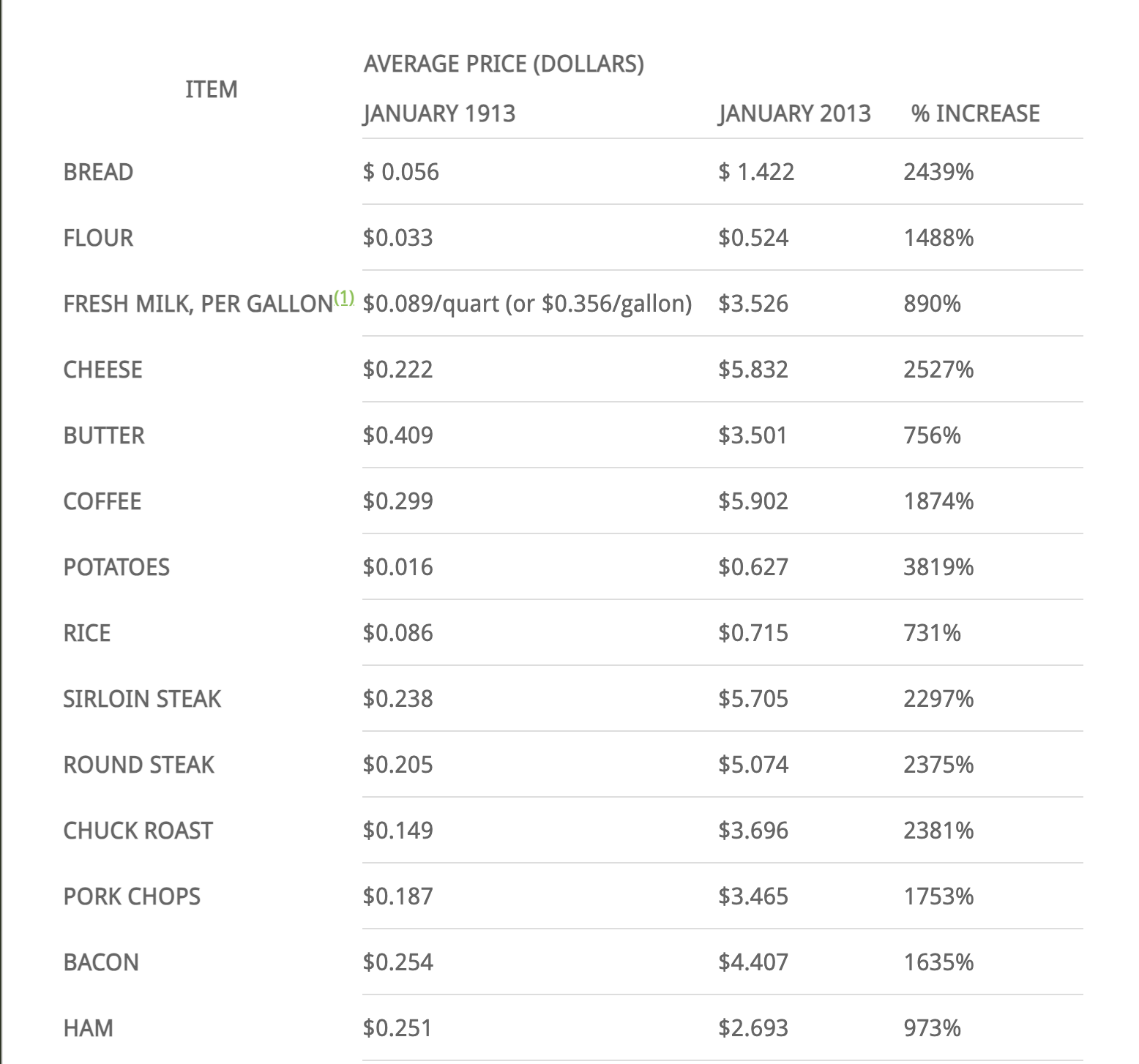
InflationData.com (2013). "Food Price Inflation Since 1913".
Despite long-run monetary inflation, real prices for many goods have declined because production has become far more efficient. U.S. cheese production, for example, rose from 418 million pounds in 1920 to 14 billion in 2023 while population grew much more slowly. That divergence is what productivity growth looks like in physical terms: more output, lower unit costs, and fewer labor hours per unit.
The important point is multiplicative interaction. Better scientific knowledge increased the return on industrial energy. Better industrial hardware increased the return on digital software. If energy, hardware, and software all improve materially at the same time, the resulting gains are likely to be larger than the sum of the individual advances.
Why This Matters Now
This matters because many current political and economic arguments still assume a relatively fixed production frontier. That assumption becomes less useful when the frontier is moving quickly.
If the next decade brings simultaneous gains in energy, hardware, and software, the central policy questions will shift. Ownership of productive systems, access to infrastructure, labor market adjustment, and distribution of gains will matter more than static arguments over how to divide current output.
The long-run opportunity is large: cheaper energy, better tools, and better automation can raise living standards dramatically. The main risk is institutional lag. Economic systems can change faster than legal, political, and social systems built for an earlier production regime. Managing that transition will matter as much as the underlying technologies themselves.